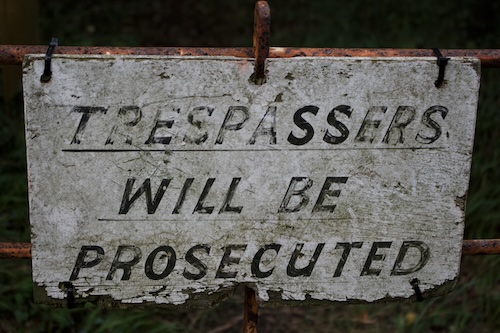
Reclaim Trespass
This post is even less coherent than usual because a) it’s some vague ideas attempting to knit a few different thoughts together and b) I have Covid like it’s 2020 and am high on Sudafed.
I read Nick Hayes The Book of Trespass recently. He sets out how the annexation of land is linked to slavery, colonialism, oppression and misogyny. Sometimes those connections become a bit stretched, but he makes several powerful points. One of these that struck home was that when authorities originally persecuted gypsies (as they referred to Roma people, thinking they were related to Egyptians), they offered them land and citizenship if they would stop travelling around. In other words, despite the massive racism and fear of different culture, the one aspect they feared more than anything else was mobility. You can’t tax, control or enforce things on people who move around all the time.
Now, I’m a very homey person, so I don’t hanker after a life on the road, but one can see an echo of this attitude in the online world also. All major platforms want you to stay within their environment. Facebook is the web for many people, and it has marketplace, video, games built in. Google now gives you AI summaries of search results so you don’t leave their site (although, they didn’t think this through as it means they lose ad revenue). In this version of land enclosures, the aim is not to tax and raise tolls but to keep data and eyeballs.
This is, of course, a long way from the open web. Even with these sites, it wasn’t that long ago that you could sync Twitter to Facebook, get RSS feeds from them, and combine everything with Yahoo Pipes. All while visiting different sites and sharing content that isn’t behind paywalls. Cory Doctorow’s enshittification thesis sets out how this happens, and why it’s bad news for us, but one could argue that the enclosure of physical spaces, blocking of routes and consolidation of wealth through land was the original enshittification.
This is all old news, and has been written about for a long time. But I think the promise of the open web has been forgotten for many people who never experienced it. The idea of the commons, shared ground that everyone can use and benefit from was behind the name of Creative Commons after all, but we’ve become so embroiled in disaster politics and AI that all that seems rather quaint now. That idealistic ship has sailed.
But has it? I warned you that this post was rambling, so the link I made next was to a book about the UK British jazz scene. This saw a revitilisation in the 2010s. Prior to this, jazz was seen as largely irrelevant, something that was the preserve of (ahem) older white men, as personified by the Fast Show’s Jazzman character (“Nice”). A young, mainly black, group of musicians influenced by grime, afrobeat, and drum n bass, began creating jazz which was mixed in with existing dance nights. These include artists that have gone on to have big success and redefine the genre including Nubya Garcia, Alfa Mist, Ezra Collective, Zara MacFarlane, The Comet is Coming, etc.
The reason this resonated with me (apart from being a fan of the artists mentioned) is that it demonstrates that it’s not too late to reclaim something. Jazz was very uncool by the 2000s, no young people forming bands were doing jazz – rap, rnb, grime, etc were all much more likely genres for anyone entering music. But by reinterpreting what had gone before, combining different genres, creating its own vibrant scene and making it relevant to political issues, the UK jazz scene regenerated it. Maybe the same message can be applied to the open web – it’s not too late to reclaim it and make something new.
Lastly, I saw George Monbiot talking on BBC Question Time where he references the book The Open Veins of Latin America, noticing that if you look at a nation’s infrastructure you can tell what kind of economy it has. If the major roads and railways link to ports and the colonial capital, rather than connecting different areas of population, then you have an extractive economy. This is definitely what you see in Wales, as coal in particular was extracted from the valleys and shipped down to Cardiff. I had a similar thought when I visited the Big Pit mining museum this summer. And this also made me consider the extractive nature of AI. The same principles apply – the internet infrastructure all drains down to one or two big sites, rather than connecting to each other. If you view AI from this perspective then the promotion of it by governments and agencies such as UNESCO becomes more questionable.
I acknowledge that there’s an element of making everything applicable to the open web in these thoughts just because it was on my mind — what do you mean Monsters Inc isn’t a scathing commentary on the consolidation of power? — but equally it was good to be reminded of the sort of issues we used to debate a lot.
(Photo by Nicola Carter on Unsplash)


