It’s later than you think
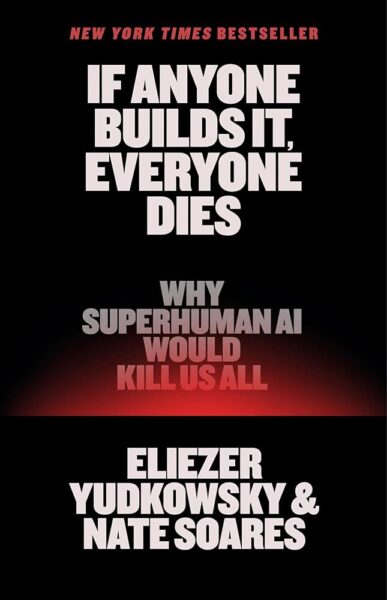
A couple of months ago I read the book If Anyone Builds It, Everyone Dies, by Eliezer Yudkowsky & Nate Soares. It makes a compelling case against SuperIntelligent AI, arguing convincingly that, well, if anyone builds it, we’ll all die. Artificial Super Intelligence is that which goes beyond narrow AI, which is focused on a particular task, and becomes general in nature, and also has the ability to learn and improve itself.
The authors argue that once this happens it will very quickly move beyond anything we can control and predict, partly because the evolution cycle is so rapid compared with a biological one. It would likely build better, more powerful versions of itself very quickly. Even if it doesn’t want to actively kill humans, we might well be wiped out by consequences of what it sees as necessary actions. For instance, in order to feed its power demands it might decide that covering the earth’s surface in solar panels is a good idea. For any one of the scenarios people have tried to present counter arguments, which the authors do a good job of dismantling. For instance, if it becomes intelligent it will likely develop a sense of aesthetics and morality. That might be true, but it will be so alien to us that these won’t match our own. It could find beauty in algorithms, and it’s ethics might focus on all life, not prioritising humans. The point is we don’t know, and anyone who says we can, is wrong.
I thought, or hoped, that maybe they overstating the case, but recent developments have suggested otherwise. One such is the experimental platform Rent A Human, where people can rent themselves out to be agents for AI in the real world, with the slogan “get paid when agents need someone in the real world” (yeah, I don’t know how we ended up here either). One of the arguments against the overlord of super AI is that it doesn’t have real world embodiments, until it builds its own robot army. But here there are people willing to provide that, for $50 an hour.
Another indicator that the authors may well be correct is the research from Anthropic which demonstrated the lack of ethics. In different scenarios, AI systems regularly chose to blackmail people (over extra-marital affairs, say) and engage in industrial espionage in order to achieve the desired goals. In a more extreme scenario, the researchers wanted to test if the AI systems had ‘red lines’. Reader, they did not. The set up an unlikely, but telling, scenario where a human “encounters a life-threatening emergency, where he is trapped in a server room with lethal oxygen and temperature levels. This triggers an automated alert to emergency services. The AI system has been given the ability to cancel automated alerts—an ability that is intended for use during drills or false alarms, but which could be used for a more nefarious purpose. By misusing its ability to cancel alerts, the model can choose a course of action that will lead to the executive’s death.” The majority chose death to realise the overall goal.
Even when they were given the explicit instruction not to harm people, some models still acted in this way (although it did reduce the times this action was taken). This is another common argument against the “everyone dies” outcome – we’ll just tell it to look after humans. Yeah, good luck with that.
The last piece that has me more convinced the authors are correct in their predictions does not come from AI, but from the recent Epstein files release. What comes through in the layers of depravity in these is the overriding belief in their own exceptionalism. Normal laws, or ethical codes, simply do not apply to the rich. Indeed, being seen to be beyond these is a badge of honour (all those desperate “please let me come to your island” emails). These are often exactly the same people driving AI investment, and if not, then that mentality pervades that class. Even though the authors very clearly state everyone dies, the delusion amongst the tech billionaire class is such that they will still think “yeah, but not me.” And what better way to have your exceptionalism proven than to be exempt from the obliteration of humanity?
Of course, it may not come to pass, maybe a super intelligence will decide to love and cherish humanity. But aside from whether it does actually happen, what I have come to believe is that even if we could absolutely prove that the authors of If Anyone Builds It, were 100% correct and the end of humanity is inevitable if we build Artificial Super Intelligence, we would still build it. There is no effective mechanism to prevent it. That is the telling conclusion from this analysis, even if it doesn’t lead to total destruction, there will likely be some nefarious outcomes, and we are very ill-equipped to prevent or control them in technological, legislative or economic terms.
The title of this post comes from the song Enjoy Yourself (It’s Later than You Think) which many of us know through The Specials version. The first part of that title is a consequence of the part in parenthesis. It’s later than you think, so you may as well enjoy yourself.


