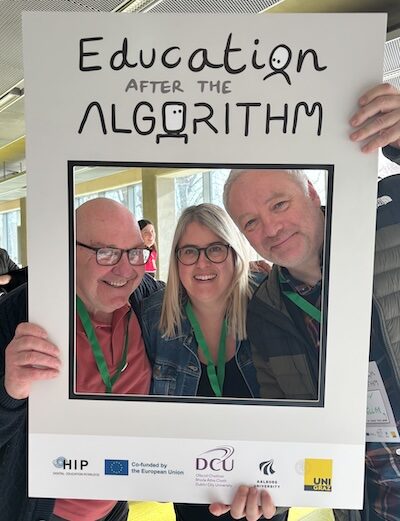
Feb 25 round up
(With Maren Deepwell and Tom Farrelly at the Education After the Algorithm seminar at DCU)
As I mentioned in a couple of posts, I gave a keynote in Dublin this month. I was also the examiner on an excellent PhD about the impact of the VLE on mental wellbeing. So, I’ve been keeping my academic hand in.
It’s an odd time to be an academic. Mind you, it’s an odd time to be anyone. Part of what you do as an academic is attempt to find the truth. I’m aware that often there is not one single truth, and conclusions can vary depending on context, but in general, research, writing, teaching is a pursuit of knowledge, and knowledge relies on some notion of truth being valuable. Amongst the many other casualties occurring (both real and metaphorical) this notion of truth being meaningful is one that I find very undermining. Even liars generally accept the notion that the truth is powerful, it’s the very fact that people value the truth that gives lies meaning. But what we’re witnessing with Trump and Musk and the mucus band surrounding them is the dismissal of truth even mattering. They say something outlandish, people respond to it, and point out that what they said is not in fact true, and they just shrug and move on. You might as well say “that doesn’t rhyme with orange” as “that isn’t true and here is the evidence”. It simply isn’t relevant whether it’s true or not. And when that is the case, we don’t have the tools to respond, our behaviours are based on people agreeing that truth matters, even if we disagree with what that might be.
Books
I’ve spoken to two other people who happened to be reading the same book as me this month, which was Laurence Rees’s The Nazi Mind; 12 Warnings From History. Hmm, I wonder why that would be. Rees’s book on the Holocaust was an authoritative and accessible account, and in this book he pulls together accounts of victims and perpetrators with elements of psychology to provide the 12 warnings. I know it’s an over-used analogy, but to say there are parallels in the US right now is no stretch – it is very clear and obvious.
Away from all that stuff, I have a theory that you could create an engaging social history course through the medium of music biographies. These so often get at social attitudes, technological and media developments and significant cultural moments. To that end I read autobiographies from Thomas Dolby and Chris Blackwell. While not necessarily the best books, they do provide a slice through all sorts of social change. The best music book I’ve read in a while is James Kaplan’s 3 Shades of Blue, which recounts the lives of Miles Davis, John Coltrane and Bill Evans leading up to, and after, the recording of Kind of Blue. It provides an intelligent analysis of the how that album fits into jazz history and styles also.
Vinyl
One of my favourite current bands, The Delines, released a new album this month. They capture perfect noir slices of life on the fringes in America, cut through with pathos and subtle observation.
Apart from that, as I mentioned in my last post, I have been on a Van Morrison riff. I owned two or three of his albums, but for some reason set off on a second had record buying spree, culminating in a tour of Dublin record shops. It’s a real pleasure to do a deep dive into an artist with a substantial back catalogue (particularly when you can pick up old albums for £8 on Discogs) and see their developments, missteps, experiments, successes and failures. I know what you’re thinking, Martin, please share with us your Van Morrison top ten albums. Oh, if you insist, although controversially, Astral Weeks is not no 1:
- Veedon Fleece
- Astral Weeks
- St Dominic’s Preview
- Moondance
- Into the Music
- His Band and the Street Choir
- No Guru, No Method, No Teacher
- Tupelo Honey
- It’s Too Late to Stop Now
- Beautiful Vision
Subscribe to the newsletter to get each month’s posts plus subscriber only content! (A new picture of my dog Teilo)


