Meet me by the blog roll
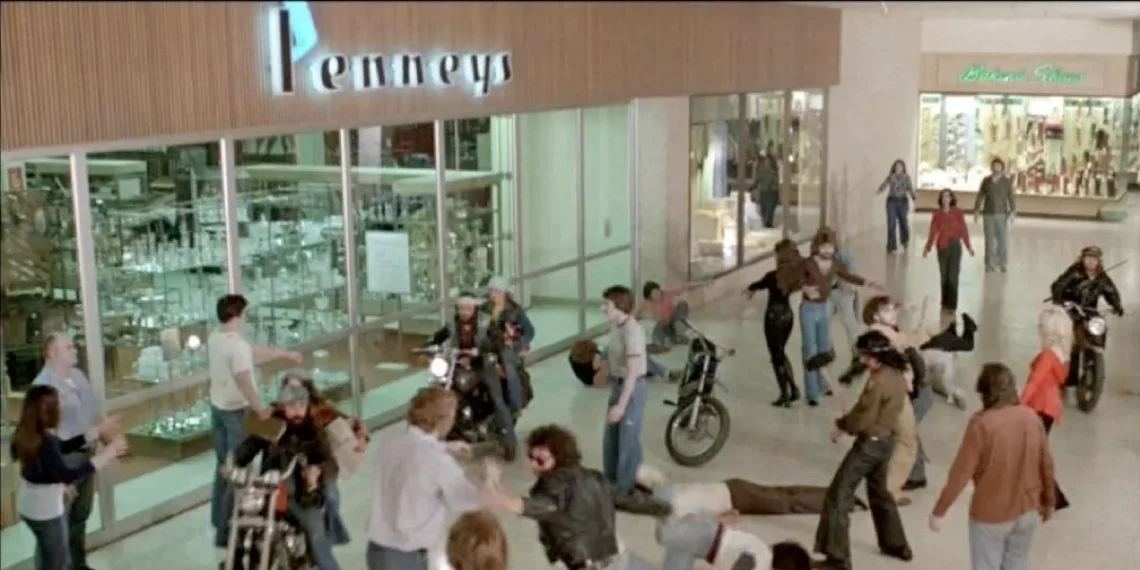
I’m quite fascinated by shopping malls. They featured so strongly in American movies of my youth, then the shopping centre spread to the UK, followed by their decline and the advent of bleak, but strangely beautiful ruin porn.
To that end, I read Alexandra Lange’s history of the mall, Meet Me by the Fountain: An Inside History of the Mall recently. It’s a fascinating account of the initial drivers for the mall, their rise, decline and subsequent reinvention. It may not be an obvious connection, but probably because I blogged about it recently, it got me thinking about parallels with the (educational) blogosphere.
First up, let’s acknowledge that there are lots of ways in which the shopping mall is nothing like the blogosphere, and in some respects, it’s opposite. The mall arose with a direct drive to consumerism, whereas blogs came from more of a counter-culture, malls are about control (with private security, limitations on signage, prescribed usage, etc), whereas blogs were about a removal of existing controls. And so on.
But it’s the similarities that are instructive I think. One characteristic of malls is that their roles quickly morphed from the predicted, or prescribed ones. They became communal places where teens could meet, their car parks were places to learn to drive, they provided first jobs, they offered safe environments for women to meet and shop, they even provided a fitness loop for elderly walkers. In the same way the blog, once established quickly became used for a variety of reasons beyond a simple journal. They became aggregation sites, makeshift learning environments, alternative communities, knowledge transfer conduits, alternative academic journals, research project hubs.
The blog and the mall both went through many changes and fulfilled many roles. For the mall this was a result of it being the only space designed to fulfil the communal role that had been ignored by rapid housing expansion. As Lange argues, it fell into gap between personal and professional. Although distinctly corporate, memories of malls were highly personal, and generally remembered fondly. The same can be said to apply to the blog – it occupied a space between the personal and professional identity of those in education, and drew its distinctiveness from this.
One of the most interesting aspects of the mall was the influence it had on downtown areas. These had often been neglected, and taken for granted. But faced with competition from malls, many towns and cities began redesigning downtown specifically drawing lessons from malls. In a similar vein, the impact of blogs can be seen in how the new media influenced traditional media. Arguably, open access journals gained traction through the public sharing of articles. Research projects began to require a social media strategy, and the concept of “research impact” had to be altered to accommodate online uptake.
But rather like shopping malls, the blogosphere saw a decline from its heyday. For malls this was a result of online shopping but also a weariness with their uniformity, and partly as a result of the successful reinvention of the downtown areas. For blogs analogous impacts were felt: a similar weariness as they became the vehicle of increasingly corporate communication; competition from other social media platforms; a general withdrawal from the early promise of online communication in an increasingly toxic environment.
But Lange’s book highlights how malls are having something of a renaissance and reinvention. Viewing them as a resource that can be repurposed has led to the mall become less homogenous and more specialised. She points to the success of ethnic malls, as Hispanic or Korean communities create vibrant, authentic spaces based around food as an example. Or the use of malls by elderly residents to create communities with better accessibility and conditions. Or the repurposing into family oriented activity centres. And so on.
The shift has been away from a uniform mall that would be the same anywhere in the country to specialised ones that become destinations. I’m not sure what the equivalent for the blogosphere is, but something around owning content, moving away from toxic sites, constructing spaces for more detailed dialogue I think has more appeal now than it did a decade ago. Reclaim the mall, reclaim the blog!


3 Comments
D'Arcy Norman
It’s not dead yet – blogrolls are still a thing. Mine’s regularly updated from my NetNewsWire subscriptions. https://darcynorman.net/blogroll/
Alan Levine
I have a bit to mall on about, they were much of the essence around my early life. I’d guess/hope Lange’s history included the early indoor mall designs of James Rouse. The home I was born into in Baltimore was very near Mondawmin Mall one of the first indoor ones closed in I think in the 1960s. I have vague memories of the wonderous feeling of the large glassed entry, it seemed magical to shop inside.
Where I spent most of my childhood was Reisterstown Road Plaza or simply “the plaza” which was an outdoor shopping center when I was a kid, then it was enclosed as an indoor mall, and later I beleive turned back to the outdoor anchor store big box anchor store complex. I hung out as a teen at Security Square Mall which later featured as a location on the first season podcast story of “Serial”. I once visited in Minnesota the Mall of America, indeed ginormous.
As a tenn I loathem them as a bit fake, sterile, with the recirculated air and faux lighting, the whole point to be seen with the popular kids (not me) and to me the metaphor is more the giant malls of social media. I like thinking of blogs as being the small ma and pa stores and homes that these places aimed to roll over.
Oh well metaphors. Live and die on ’em.
Pingback: