AI and rabbits
For my upcoming keynote at the Education after the algorithm: Co-designing critical and creative futures symposium in Dublin, I am exploring metaphors relating to ecosystems and AI. I’ll blog the whole talk after the event, but one of those metaphors I am using is the introduction of the European rabbit to Australia.
The background
During the 18th and 19th centuries, the European rabbit was introduced into Australia primarily as a food resource and for hunting activities. There is a myth that the subsequent explosion of the rabbit population can be traced back to one single introduction, that by Thomas Austin in 1859. An English settler Austin wanted to establish a rabbit population for hunting in his estate in mainland Australia, and requested that his family in England send some rabbits. This seems like one of those “too on the nose to be true” myths, but remarkably there is some genetic evidence for the single origin myth.
Surprisingly, they bred like rabbits, I mean, if only there was some way to know this advance. The species established and spread rapidly across the continent due to its high reproductive capacity and its ability to exploit a diversity of grassland ecosystems.
Roy-dufresne et al state that the European rabbit occupies over 70% of the Australian continent, suppressing the regeneration of native vegetation, competing with native and domestic mammals for food and habitat, sustaining inflated populations of invasive predators, and causing approximately A$200 million per year of associated economic losses.
BTW if you haven’t read the book or seen the film, I recommend The Rabbit Proof Fence, by Doris Pilkington Garimara. In this three aboriginal girls follow the length of the rabbit proof fence to return to their family after being forcibly removed. That isn’t the main thrust of this metaphor, but there may be something about the disregard of existing knowledge and the unequal impact of policies that could be explored.
The response
It was apparent very early that the rabbit population was a serious problem. In 1883 he Parliament of the day passed the “Destruction of Rabbits Act”. This did not have much success, relying on people to effectively hunt the rabbits to control. In 1901 a Royal Commission was appointed with the delightful naming task of to “Enquire into the Rabbit Question”.
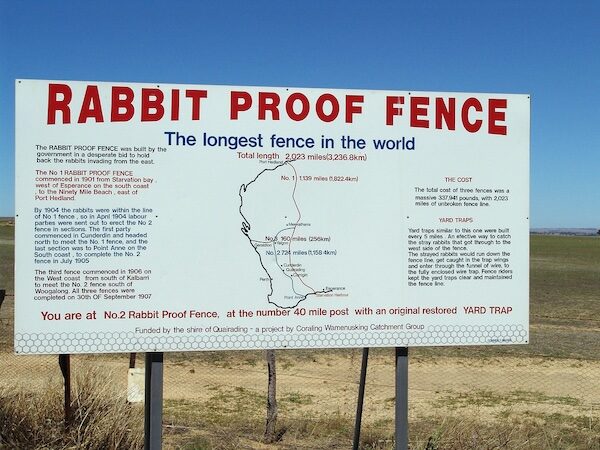
Their proposal was the construction of a rabbit-proof fence of some 500 miles. This effectively meant surrendering millions of acres of pastoral country to the rabbits. In the end three fences were constructed (imaginatively named Number 1, 2 and 3 Fences). These met with some success, but they were expensive to maintain and could fall into disrepair.
Another approach was to introduce predators to control the rabbit population. Cats and red foxes have been introduced but it seems their population is determined by rabbit population and not vice versa. This has often led to boom and bust population cycles and also prey-switching by the predators to native species.
More effective, but also more extreme is the biological warfare approach. Diseases such as myxomatosis and Rabbit Hemorrhagic Disease which target rabbits but not other species have been deliberately introduced. This has proven a more successful method, with the rebounding of native species observed although concerns about immunity developing are also valid.
The lessons for AI
If we take the information ecosystem to be analogous here to a natural ecosystem (something that could be argued), then there would seem to be a number of lessons we can draw from this historical metaphor.
Firstly, there is a rapid spread beyond the immediate area of application. We can see this with Ai bots in social media, where it is not just the immediate recipients who can be affected, but cross-fertilisation on platforms and stories picked up by traditional media mean these stories, or pieces of misinformation can spread widely.
There are unpredictable impacts. Although I mocked the carelessness above, I’m not sure anyone would have predicted just how widely rabbits would have spread, and all the different impacts they have on an ecosystem. By their very nature, ecosystems are complex, so a reduction in one species or habitat can lead to a growth in another. So with AI, we cannot predict what flooding the information ecosystem with AI generated content will mean for all sorts of practices that rely on accurate, and transparent knowledge.
Existing agents are displaced. One of the biggest impacts of the rabbit invasion is that they out-competed native species. There is an argument that we should just let such invasive species be and establish a new ecosystem. This paper argues however that “wild rabbits hold many natural Australian ecosystems in a degraded state and any beneficial ecological roles rabbits provide are small by comparison”. With AI we might argue that it is more efficient in producing summaries and provides reasonable quality output, but as this research found, the overall quality was reduced. We could create a similarly degraded state then in the information ecosystem. Also, those agents that are displaced in this case are, you know, people.
Solutions are expensive. The longer the problem goes untended then the more expensive the solutiosn become.
Possible solutions
Drawing from this metaphor, some approaches to AI could be suggested. To be clear, I’m not necessarily proposing these, my intention here is to demonstrate how we can use metaphors to think through the options when we’re confronted by something new and unpredictable. Here are some responses that I can see from the rabbit metaphor:
Do nothing. There is a school of thought that any intervention in an effort to control an invasive species causes more damage than its worth and is often unsuccessful anyway. We should just allow new ecosystems to develop and then learn to live with them. This is the libertarian wet dream.
Create human content boundaries, the knowledge equivalent of the rabbit proof fence. This would involve ring fencing certain practices as being AI-free, for example student assignments, academic journal submissions. As we have seen with the fence though this is difficult to maintain.
Introduce predators. Maybe if we have AI bits running around producing content we can train other AI bots to detect and remove this kind of content. An AI bot arms race, what could go wrong?
Legislation. Just as there is strong legislation about bringing flora and fauna into Australia we could apply strict rules about the usage of AI.
Subscribe to the newsletter to get each month’s posts plus subscriber only content! (A new picture of my dog Teilo)


2 Comments
Maha Bali
Love it, Martin. The ecosystem metaphor here is so important because you’re not focusing only on how the AI affects each individual person but entire systems of data/information/knowledge and academic systems. One person introducing it can disrupt the system. This reminds me of a student who said he was doing group work and one of the group members used AI. It doesn’t matter if no one else did, if one person did, it was done, you know?
One of my biggest fears is an invasion of AI-generared content such that we have no way to verify – unless as you say, certain spaces choose not to use AI, and we can then trust them as having normal human biases and mistakes, rather than AI ones 😉. I like humans because we can hold them accountable. Can’t do that with rabbits. Or AI.
mweller
Thanks Maha! I really like that example of one student using AI in a group project, that’s a very relatable and immediate one of AI spread in the system.